
AI & The Future of Work

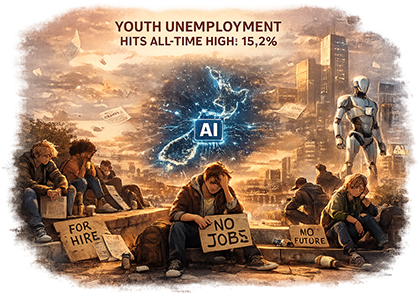
“AI is not replacing workers. It is replacing the jobs that teach people how to become workers — and New Zealand's graduates are the first to feel the draft.”
— Synthesised from Oxford Future of Work Institute findings & IDC/Deel NZ Report, 2025–2026One of the most counter-intuitive findings of recent research: the shift to remote and hybrid work has created a structural vulnerability to AI displacement. Remote work concentrates employees in document handling, email, scheduling, data analysis, and reporting — precisely the task categories most susceptible to AI automation. The Warwick/Oxford 2026 study quantifies this with striking clarity, and the implications for post-COVID New Zealand are significant.


| Role Category | AI Exposure | NZ Employment (est.) | Trend 2022–25 | Primary AI Threat | Est. Runway |
|---|---|---|---|---|---|
| Data Entry / Processing Clerks | Very High | ~8,200 | ↓ Declining Fast | OCR + LLM document processing | 1–3 years |
| Telemarketing / Outbound Sales | Very High | ~4,100 | ↓ Declining Fast | Conversational AI + voice synthesis | 2–4 years |
| Accounting / Bookkeeping Clerks | High | ~12,500 | ↓ Softening | AI accounting (Xero AI, Intuit AI) | 3–5 years |
| Junior Legal (discovery, research) | High | ~3,400 | ↓ Softening | LLM document analysis / case research | 2–5 years |
| Insurance Claims Processing | High | ~5,800 | ↓ Softening | Automated claims adjudication | 3–6 years |
| Journalism / Content Production | Medium | ~6,200 | ↓ Disrupted | Generative content at scale | 5–8 years |
| IT Support (Tier 1 Helpdesk) | Medium | ~9,100 | → Evolving | AI triage / self-resolution tools | 4–7 years |
| Retail / Customer Service | Medium | ~85,000 | → Mixed | Self-serve / AI kiosks (partial) | 5–10 years |
| Construction / Trades | Low | ~120,000 | → Resilient | Limited — physical dexterity required | 10+ years |
| Aged Care / Disability Support | Very Low | ~65,000 | ↑ Growing | Minimal — emotional intelligence required | 15+ years |

| Agency | Primary Function | AI Exposure | Planned FTE Cut (est.) | Key AI Application | Service Quality Risk |
|---|---|---|---|---|---|
| Inland Revenue (IRD) | Tax collection, compliance | High | ~750 FTE | Automated audit, query chatbot, returns processing | Medium |
| MBIE | Business services, employment | High | ~620 FTE | Permit processing, compliance monitoring | Medium |
| DIA (Births, Deaths, Passports) | Identity & citizenship services | High | ~340 FTE | Document processing, biometric ID verification | Lower — mostly routine processing |
| Ministry of Social Development | Welfare, employment support | Medium | ~980 FTE | Benefits eligibility screening, appointment triage | High — vulnerable clients at elevated risk |
| Ministry of Health | Health system oversight | Medium | ~420 FTE | Data analytics, clinical reporting automation | Medium |
| Immigration New Zealand | Visa, residency processing | High | ~380 FTE | Application pre-screening, document authenticity | High — errors have serious human consequences |
| ACC | Accident compensation | Medium | ~290 FTE | Claims triage, medical document processing | Medium — rehabilitation needs human judgement |
| Courts (Ministry of Justice) | Court administration | Medium | ~180 FTE | Document filing, scheduling, registry automation | Lower — judicial functions constitutionally protected |
| Kāinga Ora / Housing NZ | Social housing | Medium | ~220 FTE | Needs assessment triage, maintenance processing | High — housing vulnerable families |
“81% of Kiwis support stronger AI regulation — yet the government's approach has been described as 'light touch' by the very union that represents the workers most affected.”
— NZCTU / Ipsos NZ 2025
The goal is not to protect routine jobs — that argument is economically unwinnable. The goal is to ensure the transition does not strand a generation of young workers permanently below the broken rungs, and that productivity gains from AI are distributed equitably rather than captured entirely by capital.
This panel aggregates granular intelligence on skill demand shifts, emerging roles, and the AI adoption timeline in New Zealand. It is intended as an operational resource for policy-makers, career advisors, and employers navigating the transition. Data draws on MBIE vacancy surveys, Seek NZ postings analysis, LinkedIn Economic Graph NZ data, and the IDC/Deel 2025 workforce report. Australian proxy data is used and clearly labelled where NZ-specific data is unavailable.

| Emerging Role | Status in NZ | Median Salary (NZD) | Entry Requirements | Growth | NZ Demand |
|---|---|---|---|---|---|
| AI Implementation Consultant Advises orgs on AI adoption strategy and tooling | Established | $130–$190k | Tech/business + AI fluency | ↑ Strong | High — mostly filled by contractors |
| AI Prompt Engineer Designs and optimises LLM-driven workflows | Emerging | $90–$140k | Domain expertise + technical writing | ↑ Very Strong | Growing — early stage in NZ |
| AI Ethics & Governance Lead Responsible AI use, bias audits, compliance | Early Stage | $120–$180k | Law / philosophy / tech + policy | ↑ Accelerating | Low but rising — govt driving demand |
| Human-AI Collaboration Designer Designs workflows where humans and AI complement each other | Nascent | $95–$145k | UX + organisational psychology + AI literacy | ↑ Strong | Small but fast-growing in large enterprise |
| Data Quality Analyst AI training data accuracy, labelling, curation | Established | $70–$110k | Analytical background; can retrain from admin | ↑ Steady | Moderate — some offshoring |
| Automation Analyst Maps and automates business processes using AI tools | Established | $80–$130k | Business analysis + AI tool literacy | ↑ Strong | High — strong demand in finance + govt |
| AI-Augmented Legal Counsel Senior lawyers skilled in AI-assisted research and drafting | Emerging | $160–$280k | Admitted barrister/solicitor + AI proficiency | ↑ Growing | Growing — displacing junior roles as it scales |
| AI Trainer / Model Fine-tuner Human feedback for RLHF and model alignment | Early Stage | $55–$80k | Domain knowledge; accessible entry | → Mixed | Low — mostly offshore currently |